


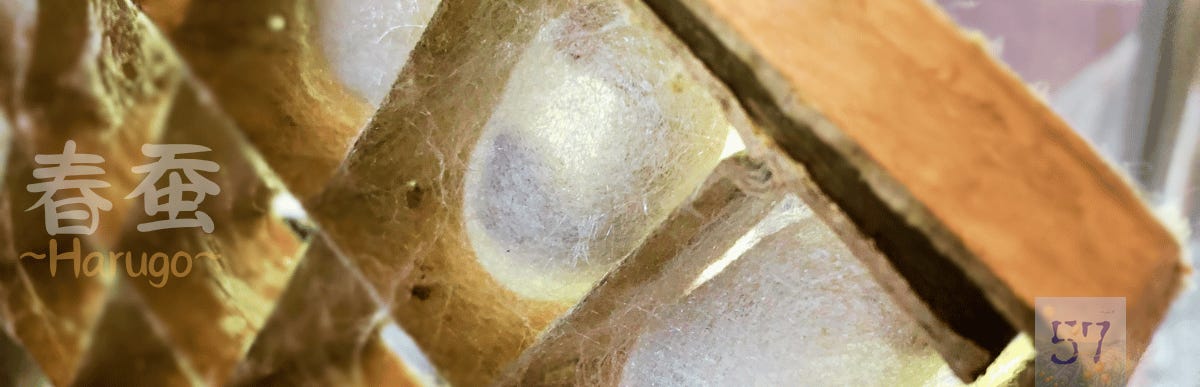
Fleeting, or Precious?
In third grade, my class raised silkworms.
It wasn’t a science lesson. Silkworms just arrived in our classroom one day. There happened to be a single mulberry tree on the school grounds, and we picked its leaves to feed them.
The silkworms spun thread and made cocoons.
Then we waited.
Eventually, moths emerged from the cocoons. They broke through from the inside and hatched. The white moths lived a short while, laid eggs, and died.
The cocoons could no longer be used as thread.
More than forty years have passed since then. Now I work in silk, in the heartlands of Japan.
In the silk industry, no moth is ever born.
When a cocoon is complete, the silkworm inside is still alive. It’s boiled in that state. Its life ends before it can become a moth. The single unwound thread can stretch hundreds of meters. In some cases, it lasts for hundreds of years.
What I witnessed as a nine-year-old was a life breaking free from its cocoon.
What I’m part of now is building the systems that carry what comes out of the cocoon to the world.
Fleeting, or precious?
Honestly, I don’t know.
The moth’s life, once hatched, isn’t long either. But it leaves eggs behind, connecting to the next life. The boiled silkworm’s life ends there. But the thread it leaves might remain, for a very long time.
I can’t say which is right.
In the last issue, I wrote about Hari-Kuyō — the Japanese custom of holding a memorial for worn-out needles, giving thanks for their work. I wrote about how a sense that the divine dwells in all things runs beneath our culture.
That hasn’t changed.
But standing in front of these silkworms, those words carry more weight than before.
How should we treat something the divine dwells in? How are we even allowed to?
I still don’t have an answer.
At 57, becoming a new recruit, one of my first jobs was building the systems that carry what comes from these cocoons out into the world.
The child who once picked mulberry leaves in a schoolyard is here now. I find it hard to believe that’s a coincidence.
Did I choose this path, or was I led to it? I don’t have an answer to that question either.
Is there something in your life that feels fleeting, and precious, at the same time?
Are those two things really in conflict?
The Assumption That “IT Is Something You Outsource”
I wrote an article on Note about choosing tools for building a website.
But what I actually wanted to write about wasn’t the tools.
At 57, becoming a new recruit, one of the first things I did was redesign our website’s entire foundation from scratch.
For over a decade, going back to my farming days, I tested no-code website builders around the world — with my own hands and my own money. Failures, switches, over and over. In small pockets of time, bit by bit. That accumulated trial and error became immediately useful on my very first day at this new job.
I told the founder: “If you leave everything to an outside agency, every improvement costs you money and time. You lose the ability to move.”
That’s something ten years of farming had taught me, deep in my bones.
I carry a sense instilled in me as a former aircraft maintenance engineer: a tool you can’t maintain yourself isn’t something you should trust, from a safety standpoint. I think the same is true for websites, and for business itself.
Holding the reins of your own tools is, I believe, the same thing as holding the reins of your own business.
And yet, this isn’t common sense in Japan — not by a long way.
About 70% of Japan’s IT workforce is employed by vendor companies, with only around 30% working inside user companies. In the US, it’s the reverse: nearly 70% of IT talent works inside user companies.
It’s a survey from about three years ago, but the structure — “IT is something you ask an expert to build for you” — has persisted for so long that 70.6% of small business owners said they’d “never heard of” SaaS, and SaaS adoption among small businesses stood at just 6%. I doubt this has changed much since. And if it hasn’t, it may well be part of why AI adoption is lagging too.
The idea of “choosing your own tools and building it yourself” doesn’t have much soil to grow in here, to begin with.
There’s one thing I’d like to say to anyone coming to do business in Japan from abroad.
If you step in assuming the IT self-sufficiency that’s normal in the West, you might find yourself in an unexpected swamp. That’s not a matter of ability. It’s a structural problem that’s built up over many years.
As for me, I brought the “ability to choose my own tools,” built up over more than a decade, into this job as a 57-year-old new recruit. It’s turned out to be my strongest weapon.
I wrote the details of how I chose my tools in a Note article.
Back to Japan #1
Miyuki Nakajima, “ 時代 ~Jidai~” (The Times, 1975)
Fleeting, or precious? That question stayed with me the whole time I was writing this issue.
I was listening to this song while I sat with it, still without an answer.